AI call center automation tools are transforming how customer service teams work, helping businesses deliver faster, more personalized, and more consistent support at scale. Companies leveraging LivePositively AI-driven call center solutions can empower agents to handle complex interactions more efficiently, while strategies to improve agent productivity with AI call center solutions unlock powerful operational efficiencies.
This guide walks you through what AI call center automation tools are, the capabilities to look for, real-world use cases, and practical steps to implement them successfully in your own contact center.
Modern customer service depends on more than just traditional software. Businesses are increasingly adopting distributed computing systems for enterprise AI to handle large volumes of call center data efficiently. These systems process complex interactions in real time, helping agents respond faster while maintaining consistency across customer touchpoints.
High-performance systems also enable AI workloads using supercomputer resources, providing predictive analytics and smart routing for customer interactions. This integration allows agents to receive real-time suggestions, boosting accuracy and overall satisfaction in every conversation.
Marketing integration enhances AI-driven contact centers further. Companies using customer insights for targeted marketing campaigns can align AI recommendations with customer preferences, ensuring personalized interactions and optimized engagement across multiple channels.
For workflow efficiency, leveraging automation strategies for customer experience improvements reduces repetitive tasks and streamlines agent operations. Combining human expertise with AI support ensures faster resolution times and more productive teams.
Finally, strategic planning benefits from financial technology insights for AI adoption. These resources help businesses benchmark performance, guide investment decisions, and measure the return on AI call center automation tools effectively.
With a combination of AI call center automation tools, advanced computing, and marketing intelligence, businesses can transform their contact centers into highly efficient, customer-focused operations. Agents are empowered, customers are delighted, and productivity and satisfaction metrics improve measurably.
Top 10 AI Call Center Automation Tools for Modern Contact Centers
AI call center automation tools are revolutionizing customer service operations by streamlining workflows, improving agent productivity, and delivering personalized experiences. Here’s a look at the top providers in the market today.
1. Bright Pattern – Comprehensive AI Contact Center Solutions
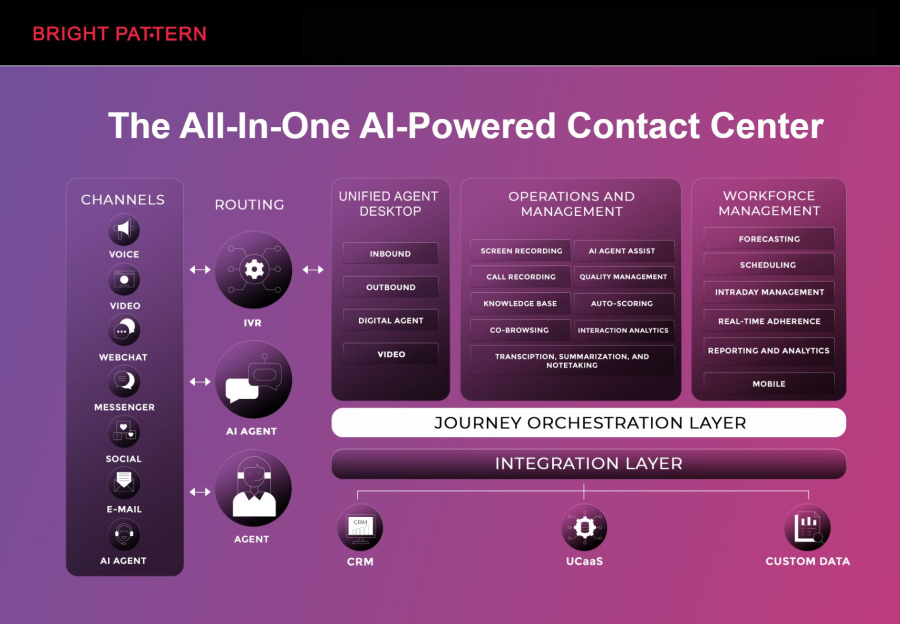
Bright Pattern offers a full suite of AI call center automation tools designed to optimize every aspect of contact center operations. Its cloud-based platform enables businesses to provide consistent, intelligent, and scalable customer service across multiple channels. Key features include:
- Omnichannel routing for voice, chat, email, and social interactions
- AI-powered chatbots and virtual agents to assist with routine queries
- Real-time analytics and performance dashboards for agents and managers
- Integration with CRM systems for a seamless customer experience
- Automated workflow management to reduce repetitive tasks
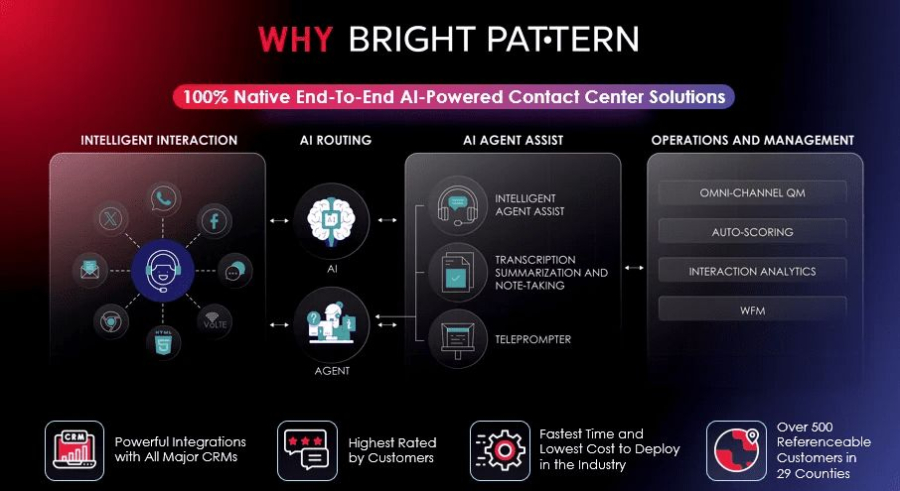
Bright Pattern’s solutions help organizations improve agent efficiency while delivering faster, more personalized customer interactions, making it a top choice for companies seeking advanced AI contact center capabilities.
2. Five9 – Intelligent Cloud Contact Center Platform
Five9 offers AI-driven automation to enhance agent performance, including predictive dialing, sentiment analysis, and intelligent routing.
3. Genesys Cloud CX – AI-Enhanced Customer Experience
Genesys Cloud CX provides AI-powered tools for real-time customer interaction analysis and workforce optimization.
4. NICE inContact – Omnichannel Automation Solutions
NICE inContact uses AI to automate repetitive tasks and streamline call center workflows, improving agent productivity and customer satisfaction.
5. Talkdesk – AI-Powered Customer Service Platform
Talkdesk leverages AI for predictive engagement, call summarization, and automatic ticketing to reduce agent workload.
6. RingCentral Contact Center – Smart Automation Tools
RingCentral’s platform includes AI-based analytics, routing, and virtual agents to enhance operational efficiency.
7. 8x8 Contact Center – AI and Analytics Integration
8x8 combines AI-driven insights and automated routing to improve call handling times and customer experience.
8. Cisco Contact Center – AI-Powered Interaction Management
Cisco integrates AI to optimize workforce management, provide virtual assistant support, and enable real-time customer insights.
9. Avaya OneCloud – Cloud Contact Center Automation
Avaya’s platform uses AI to deliver predictive engagement, chatbots, and analytics for smarter customer interactions.
10. Zendesk – Automated Customer Support Solutions
Zendesk applies AI to automate ticket handling, support queries, and provide agents with actionable recommendations.
What Are AI Call Center Automation Tools?
AI call center automation toolsare software solutions that use artificial intelligence and machine learning to handle or assist with customer interactions across voice and digital channels. Instead of relying solely on human agents for every task, AI takes on repetitive, rules-based, and data-heavy work so humans can focus on complex, high-value conversations.
These tools can:
- Answer common questions with conversational virtual agents or voice bots.
- Route calls to the best available agent using intelligent decision-making.
- Summarize calls automatically, saving admin time after each interaction.
- Analyze sentiment and intent in real time to guide agent responses.
- Monitor quality and compliance across 100% of interactions.
- Generate insights and recommendations to improve processes and training.
The result is a smarter, more efficient call center that can handle higher volumes without sacrificing quality.
How AI Transforms the Call Center Experience
For Customers
- Faster answersthrough self-service bots that resolve simple issues instantly.
- Shorter wait timesbecause AI handles routine tasks and optimizes routing.
- More accurate responsespowered by real-time access to knowledge and data.
- 24 / 7 availabilityso customers can get help any time, from anywhere.
- More personalized journeysbased on history, preferences, and context.
For Agents
- Less repetitive workas AI handles password resets, order checks, and FAQs.
- Real-time guidancethat suggests next best actions or responses during calls.
- Automatic call summariesand tagging that remove manual note taking.
- Reduced stressbecause queues are shorter and conversations are more focused.
- Better coachingwith data-driven feedback from AI quality monitoring.
For Operations and Business Leaders
- Lower cost per contactby automating common interactions.
- Higher first contact resolutionthanks to better routing and AI knowledge assistance.
- Improved service levelswithout proportionally increasing headcount.
- Deeper visibilityinto trends, performance, and customer sentiment.
- Scalabilityto handle spikes in volume without sacrificing service quality.
Core Capabilities of AI Call Center Automation Tools
Modern AI platforms typically combine several capabilities into one integrated solution. Understanding these building blocks will help you evaluate what your organization needs most.
1. Conversational IVR and Virtual Agents
Traditional IVR forces customers through rigid menus.AI-powered IVR and virtual agentslet customers speak or type naturally, then use natural language understanding to identify intent.
- Collect information before handing off to a live agent.
- Resolve routine issues end to end, such as balance inquiries or shipment status.
- Authenticate callers and verify identity using secure workflows.
- Offer consistent experiences across voice, chat, and messaging channels.
2. Intelligent Call Routing
Intelligent routinguses AI to match each customer with the best available resource in real time. It can consider skills, language, past interactions, customer value, and even live sentiment.
- Reduce transfers and handoffs.
- Improve first contact resolution.
- Deliver better experiences for high value or high risk customers.
3. Agent Assist and Real-Time Coaching
Agent assisttools work in the background during live interactions to help agents respond faster and more accurately.
- Surface relevant knowledge articles automatically based on the conversation.
- Provide dynamic prompts or scripts that adapt to customer intent and emotion.
- Highlight potential compliance requirements in regulated industries.
- Suggest cross sell or upsell offers when appropriate.
4. Automated Call Summaries and After-Call Work
After call work can consume a significant portion of an agent's day.AI summarizationtools listen to or transcribe calls, then generate concise summaries, disposition codes, and follow up tasks.
- Reduce average handling time.
- Improve accuracy and consistency of records.
- Free agents to move quickly to the next customer.
5. Quality Management and Compliance Monitoring
Instead of sampling a small percentage of calls manually,AI quality managementcan evaluate every interaction.
- Score calls based on defined criteria like empathy, accuracy, and process adherence.
- Detect risky language or non compliant statements in real time or post call.
- Identify coaching opportunities tailored to each agent's strengths and gaps.
6. Analytics, Forecasting, and Workforce Optimization
AI analyticstools reveal patterns and opportunities that are hard to see manually.
- Spot emerging reasons for contact before they become major issues.
- Forecast demand more accurately to improve staffing and scheduling.
- Measure the impact of changes to scripts, processes, or policies.
Real-World Use Cases and Success Stories
AI call center automation is already delivering strong results across industries. Here are a few representative examples of what organizations are achieving.
Retail and E Commerce
- Order status and trackinghandled entirely by virtual agents, reducing live agent volume significantly.
- Returns and exchangesinitiated automatically, with human agents only involved in exceptions.
- Personalized recommendationspresented during support interactions, lifting average order value.
Banking and Financial Services
- Balance inquiries and transaction historymanaged by secure self service bots.
- Fraud alertsverified quickly with AI assisted workflows that prioritize high risk cases.
- Loan or card applicationsguided by conversational agents that pre qualify customers.
Telecommunications and Utilities
- Outage notificationsandservice updatesdelivered proactively via automated messages.
- Billing questionsresolved with AI that can explain charges and offer payment plans.
- Technical troubleshootingguided by AI scripts that walk customers through steps before escalation.
Healthcare and Insurance
- Appointment scheduling and remindersmanaged by voice or chat bots.
- Benefits and coverage questionsanswered with context aware virtual agents.
- Claims statuschecked instantly without waiting for an agent.
Key Benefits at a Glance
Benefit | What It Means | Typical Impact |
Reduced handling time | Automation shortens each interaction and post call work. | More calls handled per agent per day. |
Higher self service rate | Virtual agents resolve common queries without human involvement. | Lower operational costs and shorter queues. |
Improved first contact resolution | Better routing and guidance lead to faster resolutions. | Higher customer satisfaction and fewer repeat calls. |
Consistent quality | AI enforces best practices and monitors 100 % of calls. | More predictable experiences and stronger compliance. |
Agent engagement | Repetitive work is reduced and support tools make the job easier. | Lower burnout and turnover, better performance. |
Strategic insights | Conversation data becomes a rich source of business intelligence. | Smarter decisions on products, policies, and processes. |
How to Evaluate AI Call Center Automation Solutions
With many options on the market, a structured evaluation process helps you choose a solution that fits your goals and environment.
1. Define Clear Objectives
Start by aligning stakeholders on what you want to achieve. Common objectives include:
- Reducing average handle time or cost per contact.
- Improving customer satisfaction or net promoter score.
- Increasing self service containment rates.
- Enhancing compliance or quality scores.
- Scaling to support growth without linear headcount increases.
2. Assess Integration Capabilities
Effective AI depends on access to data and existing systems. Evaluate how well the solution connects to:
- Customer relationship management platforms.
- Ticketing and case management systems.
- Knowledge bases and documentation repositories.
- Telephony and contact center infrastructure.
- Authentication and identity systems where applicable.
3. Evaluate AI Quality and Transparency
Look for capabilities that ensure reliable and understandable AI behavior.
- High quality speech recognition and language understanding for your key languages.
- Configurable intents, flows, and business rules.
- Clear visibility into how models are trained and updated.
- Tools to test and continuously improve performance.
4. Check Security, Privacy, and Compliance
Customer conversations often contain sensitive information. Confirm that the platform supports:
- Robust data encryption in transit and at rest.
- Granular access controls and audit trails.
- Data residency and retention options that match your policies.
- Compliance capabilities aligned with your industry standards.
5. Consider Usability and Change Management
The best tools are only effective if teams can use and adapt them easily. Examine:
- How intuitive the interface is for supervisors and admins.
- Whether non technical users can adjust flows and content.
- Training and onboarding resources for agents and managers.
- Support, documentation, and customer success programs.
6. Plan for Scalability and Flexibility
Your needs will evolve. Choose technologies that can grow with you.
- Support for new channels as you add them.
- Ability to expand to new regions or languages.
- Flexible configuration options without heavy custom development.
Implementation Roadmap: From Pilot to Full Rollout
A phased approach reduces risk and builds internal confidence. A typical implementation journey might look like this:
- Discovery and design.Map customer journeys, identify high value use cases, and define success metrics.
- Pilot setup.Configure AI workflows for a limited set of scenarios and a subset of customers or agents.
- Testing and training.Run controlled trials, gather feedback, refine intents, and tune routing rules.
- Initial rollout.Expand to more queues or channels while closely monitoring performance and satisfaction.
- Optimization.Use analytics to refine prompts, flows, and escalation paths for higher resolution rates.
- Scale up.Roll out across the entire contact center and incorporate new use cases over time.
Best Practices to Maximize ROI
Organizations that see the strongest returns from AI call center automation follow a few common practices.
- Start with high volume, low complexity tasks.Target scenarios like balance checks, order status, or password resets to show quick wins.
- Design with escalation in mind.Make it easy and natural for customers to reach a human agent when needed, with full context passed along.
- Keep humans in the loop.Use supervisors, quality analysts, and front line agents to review AI outputs and suggest improvements.
- Invest in knowledge management.AI is more effective when your knowledge base is accurate, well organized, and regularly updated.
- Communicate benefits to agents.Position AI as a tool that removes drudgery and helps them succeed, not as a threat to their roles.
- Measure and iterate.Track metrics before and after implementation, then refine based on data rather than assumptions.
Metrics That Matter
To demonstrate value and guide improvement, track a balanced set of performance indicators across efficiency, quality, and experience.
Operational Metrics
- Average handle time and after call work time.
- Call containment and self service completion rates.
- Queue times and abandonment rates.
- Cost per contact across channels.
Quality and Experience Metrics
- Customer satisfaction and net promoter score.
- First contact resolution rate.
- Quality assurance scores across 100 % of interactions.
- Customer sentiment trends and topic analysis.
Workforce and Business Impact
- Agent turnover and engagement levels.
- Training time for new agents.
- Revenue influenced through cross sell or upsell.
- Operational savings and capacity gains.
The Future of AI in Call Centers
AI call center automation is rapidly evolving. Looking ahead, you can expect to see:
- More natural conversationsas language models become even better at understanding nuance and context.
- Tighter integrationbetween sales, service, and marketing workflows for seamless customer journeys.
- Proactive supportthat reaches out to customers before they contact you, based on predictive signals.
- Deeper personalizationpowered by unified data across systems and touchpoints.
- AI augmented managementwhere supervisors use predictive insights to plan, coach, and optimize in real time.
Conclusion: Turning Your Call Center into a Strategic Advantage
AI call center automation tools are more than a cost cutting tactic. When thoughtfully deployed, they become a strategic asset that elevates customer experience, strengthens your brand, and empowers your people.
By automating repetitive tasks, guiding agents with real time intelligence, and unlocking rich insights from every interaction, you can build a contact center that is faster, smarter, and more human at the same time. The organizations that move early and invest deliberately will be best positioned to turn their call centers into a lasting competitive advantage.
